
Connectivity as Capital
How Grass and similar networks turn residential bandwidth into a distributed economic layer for AI infrastructure and data markets
Amiar
5/19/20264 min read
When connectivity becomes a resource
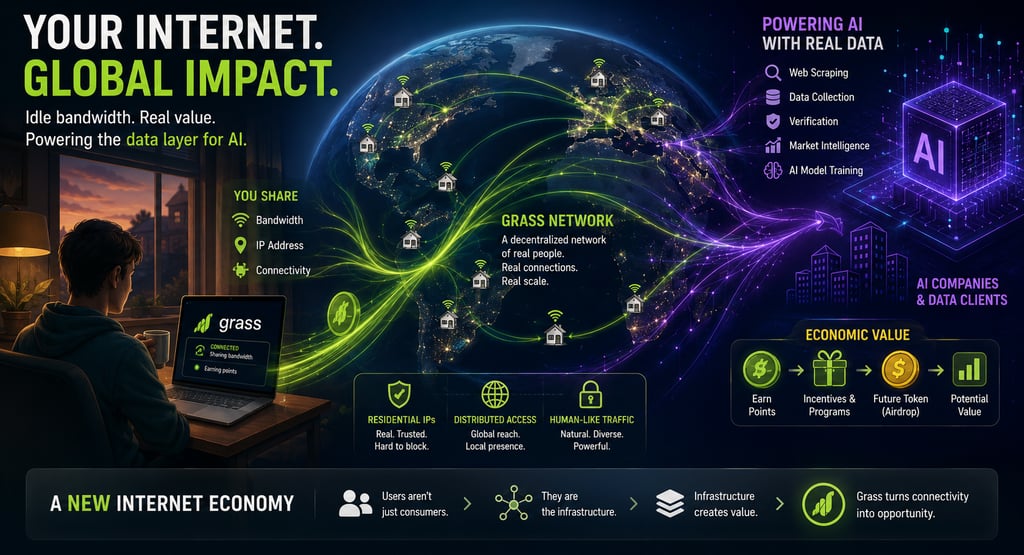
Grass (Grass.io) positions itself at an unusual intersection of internet infrastructure, crypto economics, and data collection for artificial intelligence. On the surface, the concept is simple: users share part of their internet connection through a browser extension and are rewarded for doing so. But what looks like a “passive income” system hides a more structural proposal: the transformation of residential traffic into global economic infrastructure.
What is at stake is not just an application, but an emerging model for organizing the internet itself as a distributed economic resource.
The core principle: monetizing idle capacity
The starting point of Grass is a familiar idea in the digital economy:
underutilized resources can be converted into economic value.
In Grass’s case, the resource is unused residential bandwidth. The company proposes that this capacity be “leased” through a browser extension installed by the user.
Operationally:
the user installs an extension;
part of their internet connection is made available as a network node;
that capacity is aggregated with that of other users;
the resulting network is sold as data infrastructure.
(grass.io)
The promise is straightforward: turning an invisible resource (unused broadband capacity) into economic value.
The user as infrastructure node
The most structurally important element of the model is the role reversal between user and infrastructure.
In the traditional internet model:
companies operate servers and networks;
users consume services.
In the Grass model:
users become active infrastructure nodes;
their internet connection becomes part of a distributed network;
this network is used for external tasks, primarily data-related ones.
This represents a subtle but significant shift:
the user is no longer only a consumer, but a functional component of digital infrastructure.
The invisible layer: data for artificial intelligence
Although the project’s public language often focuses on “passive income” and “shared internet,” the more relevant layer is the use of this network for data collection and transport for AI.
Grass positions itself as infrastructure capable of:
collecting distributed public web data;
supporting scraping and verification tasks;
providing geographically distributed access capacity;
feeding data pipelines for machine learning models.
(coingecko.com)
In this sense, the network is not only technical — it is economic. The value lies not in connectivity itself, but in the ability to transform connectivity into access to data.
Residential networks as a strategic asset
One of the most important resources in this model is so-called residential IPs — IP addresses associated with real home internet connections.
These IPs are valuable because:
they are harder to detect as automated traffic;
they allow more “natural” access to web services;
they bypass scraping restrictions and blocks;
they simulate distributed human behavior.
Grass aggregates these IPs into a coordinated network, creating infrastructure that resembles:
distributed proxy networks;
decentralized scraping systems;
web access layers for automated agents.
The “points” economy: deferred incentives and speculation
Grass does not directly pay in fiat currency in most cases. Instead, it uses a system of:
points
incentive programs
expectations of future token conversion
(coingecko.com)
This model has three structural effects:
early adoption without direct financial friction
rapid scaling of the user network
creation of speculative expectations (future airdrops)
Economic value is shifted from the present into potential future value, creating a hybrid system between infrastructure and promise.
Distributed infrastructure or cost externalization?
A central question raised by this model is:
who actually pays for the network infrastructure?
At first glance, the answer seems to be: users do not pay, they only receive.
But in practice:
users provide broadband capacity;
they provide residential IPs;
they provide electricity and hardware;
they provide network availability.
In other words, a significant portion of infrastructure cost is externalized to individuals.
In this sense, Grass acts as a mechanism for redistributing the costs of digital infrastructure — but without a traditional model of proportional compensation for the value generated.
Between utility and technical gray zones
The use of residential proxy networks inevitably raises technical and ethical questions.
This type of infrastructure can be used for:
public data collection;
geolocation testing;
market monitoring;
large-scale scraping;
accessing services across regions.
But it can also enter a gray zone:
simulating human traffic;
bypassing platform restrictions;
non-transparent use of residential IPs.
The result is a system with a dual nature:
legitimate data infrastructure;
potentially ambiguous web usage network.
The parallel with other invisible infrastructures
Grass is not entirely isolated. It resembles existing systems such as:
CDN and edge computing networks (distributed infrastructure)
residential proxy platforms
crowdsourced data systems
attention and data economies on the web
The difference is that here the infrastructure is not institutional or corporate — it is decentralized across ordinary users, who function as semi-voluntary or involuntary micro-servers.
The internet as a distributed economic resource
The most important conceptual point of the model is the transformation of home internet into an economic asset.
Historically:
the internet was an access medium;
then it became a means of data production;
now it is becoming a means of infrastructure production.
Grass represents this transition:
from internet as consumption → to internet as distributed productive capacity.
In this model, connectivity is no longer just a service, but an economically exploitable resource.
In retrospect
Grass should not be understood merely as a browser extension or a crypto passive-income promise.
It represents an attempt to build a new layer of the internet based on three principles:
use of residential infrastructure as a global resource;
economic incentives through points and token systems;
integration of this infrastructure into AI data pipelines.
What emerges is not just an application, but a prototype of economic reorganization of the network itself:
an internet where users are not only accessing systems — but becoming part of their operational infrastructure.
Our Socials
Join our community or directly ask any question, we are happy to clarify
Book a call?

2026. All rights reserved. ThEndorSemenT is a non-profit initiative and does not constitute an investment vehicle or financial service under applicable regulations











parent organization



NEWSLETTER
IMPACT
Transparent systems that empower informed participation and shared responsibility
4 Incubated projects
1 Endorsed brand
€30K Funding secured
Transparency is the way